Every car on the road is one flat battery, one failed MOT, or one interesting noise away from being a non-runner, and the UK is full of cars that reached that state and then stopped moving altogether: projects on axle stands, barn finds under blankets, salvage lots, and EVs that ran out of electrons in awkward places. Moving a car that cannot move itself is a solved problem with the right equipment and the right information. This guide covers both: how professional non-runner transport works, and what you need to tell your transporter to make it routine.
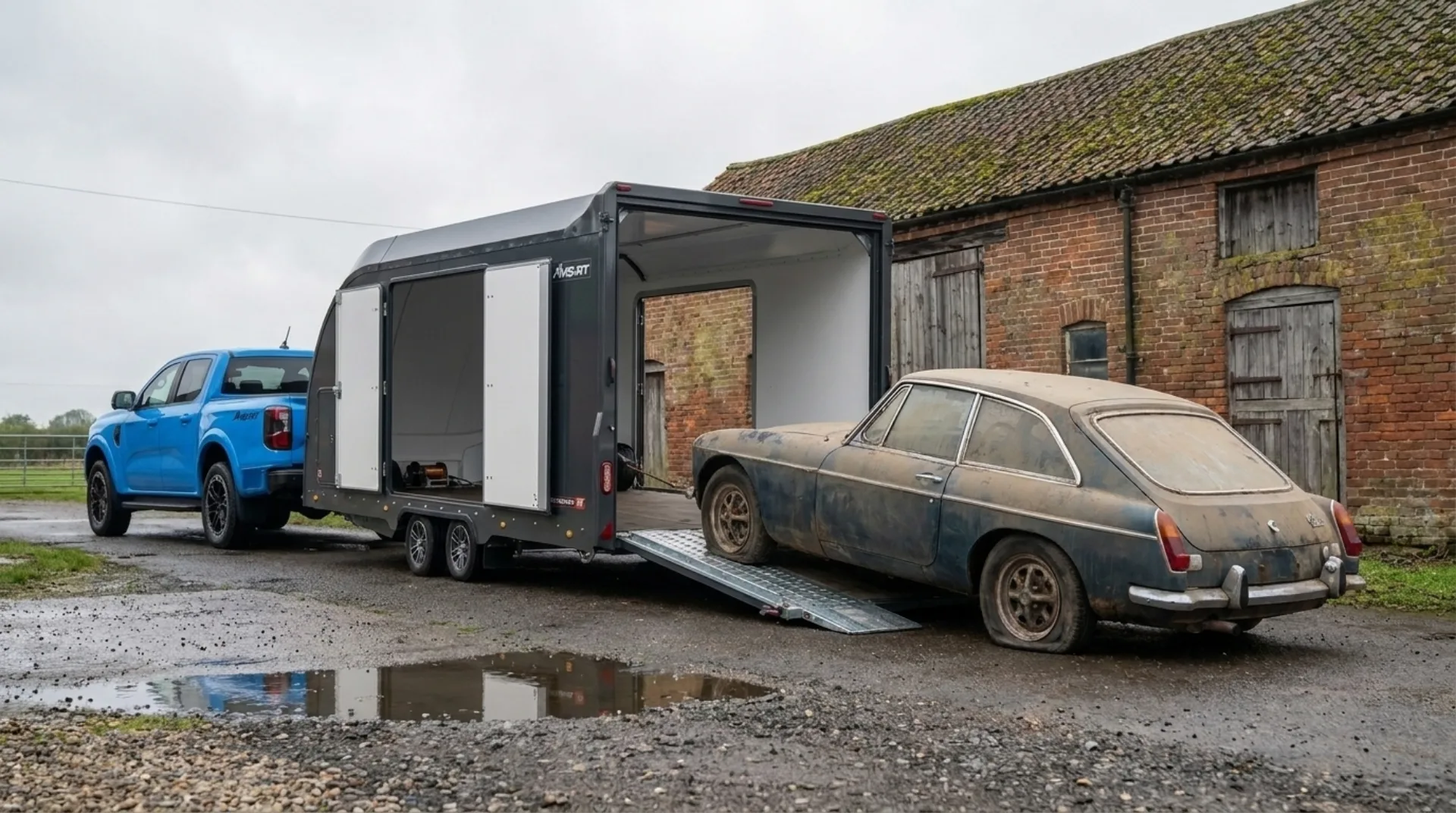
The term covers a spectrum, and where your car sits on it changes the job. At the gentle end: a car that is mechanically fine but cannot be driven, a flat battery, no keys, a failed MOT, a SORN declaration. In the middle: cars that genuinely do not run, dead engines, failed clutches, electrical gremlins, but roll and steer freely. At the demanding end: cars that resist moving at all, seized brakes, locked steering, missing wheels, accident damage, or a rolling shell mid-restoration.
All three bands are transportable. The difference is planning: the gentle end loads almost like a runner, the middle is a standard winch job, and the demanding end needs the transporter to know exactly what they are arriving to. The single most useful thing you can do when booking is place your car honestly on this spectrum, and the three questions that place it are covered below.
Requirements can vary with the vehicle, route, and circumstances. Check current official guidance for your situation before arranging a movement, particularly where registration, roadworthiness, or cross-border travel is involved.
For a useful transport conversation, share the vehicle's condition and access, the collection and delivery locations, and any information that may affect the movement. This guide is practical preparation, not legal advice.
A non-runner needs an accurate description before a provider can plan the collection. Explain whether the vehicle rolls, steers, and brakes, and include photographs where they clarify the condition or access.
Collection access matters too. Describe the vehicle's position, the available space, and anything that may affect moving it from the site. This helps the provider discuss an appropriate plan instead of relying on assumptions.
For a planned movement, see Towit's vehicle recovery service and share the collection, delivery, vehicle-condition, and access details when requesting a quote.
Everything a transporter needs to plan a non-runner collection compresses into three questions. Swipe through what each answer changes.
Swipe through the triage
Free-rolling wheels make everything routine. Seized brakes or locked hubs do not stop the job, but they change the equipment and the time, so they must be declared, not discovered.
A steerable car can be guided up the bed on the winch line. A locked column or disconnected steering means straight-line planning and more careful positioning of trailer and car.
Some braking, even just a handbrake, helps control the car during positioning. None at all is fine and common; it simply means chocks and the winch do all the holding, and we arrive knowing that.
A little battery unlocks steering locks, releases electronic handbrakes, and opens EV parking pawls. If the car is completely dead, say so; there are workarounds for most of it, all of which go better planned.
Answer those honestly and almost any car becomes a scheduled, uneventful collection. The failures in this business are nearly all information failures: the 'non-starter' that turned out to be wheel-less on stands, the 'rolls fine' with two seized calipers. Nobody minds the hard version of the job; they mind meeting it unannounced.
Tell us the vehicle condition, whether it rolls, steers, and brakes, and both postcodes so we can discuss the movement.
Non-runners have a talent for being in awkward places: the back of a garage behind a freezer, a field with a soft gateway, an underground car park with a height limit, the far side of a gravel drive with an incline. Since the car cannot reposition itself, the trailer and winch have to work with wherever it sits, which makes access information as important as the car's condition.
When booking, describe the ground between the car and where a trailer can realistically stand: distance, surface, slopes, gates, overhangs, and tight turns. Winch lines have length, and cars can be repositioned in stages, but the plan has to be built on reality. Photographs of the car in place, taken on your phone, are worth a paragraph of description and take thirty seconds to send over WhatsApp.
The same applies at the delivery end, especially for workshops with yards, storage units in complexes, and home garages on busy roads. A non-runner cannot be left idling on the kerb while details are worked out; it goes where the plan says it goes, so the plan needs the truth in advance.
Swipe through the common jobs
Copart and salvage purchases that were never going to drive home. Collected from the compound against the storage clock, photographed before leaving, delivered to the workshop.
Half-finished restorations sold on with boxes of parts. The car travels secured, the boxes travel declared, and the new owner starts with everything that was promised.
Cars surfacing after decades, often precious, often fragile, often behind a wall of garden equipment. Gentle winching, honest access planning, and unhurried handling.
Flat traction batteries and bricked software. EVs mostly should not be towed and cannot be driven flat, so the winch and trailer are not just best practice; they are the only practice.
Accident-damaged cars going from home or a holding yard to a bodyshop, planned rather than emergency. Damage is photographed precisely before the move separates old harm from the journey.
Legally unmovable under their own power, trivially movable on a trailer: to the garage for the work, to a new owner, or into storage until their turn comes.
Here is the complete briefing that makes a non-runner collection go perfectly, expanded from the triage above.
Non-runner and high-value are not opposites. A supercar with an electronic fault, a concours classic between restoration stages, a rare barn find on its way to a new custodian: these cars cannot drive and also cannot be exposed. The answer is the same enclosed Race Transporter 7 used for running supercars, with the winch doing the loading. Full weather protection, full discretion, soft straps, and a photographic condition report bracketing the move.
The economics follow the car, not the fault. A vehicle worth enclosing when healthy is worth enclosing when broken, arguably more so, since a car heading for repair or sale has its value under more scrutiny, not less. Our enclosed vs open guide applies unchanged; simply add the winch.
Different ways of moving a non-runner can have different requirements and risks. Check current official guidance before considering self-towing or a hired trailer, and make sure any provider receives an accurate description of the vehicle and access.
A planned collection should be discussed using the vehicle's condition, the collection and delivery locations, access constraints, and any manufacturer guidance that may apply. This helps avoid assuming that one method is suitable for every non-runner.
For a planned movement, share the details with a provider and ask how the collection would be assessed before agreeing to a service.
Non-runners attract inertia. The car is not going anywhere, so moving it never becomes urgent, and months pass with it occupying a compound at daily rates, a driveway at neighbourly ones, or a barn where the damp does its quiet work. Waiting has real costs, and they compound.
Stored badly, cars deteriorate as they sit: brakes seize against discs, tyres flat-spot and perish, fuel goes stale and varnishes systems, batteries die past recovery, and rodents move into wiring looms. Each month of sitting can move a car down the spectrum from 'rolls, steers, brakes' towards the demanding end, which makes the eventual move harder and the quote higher. A salvage car in a fee-charging compound has the same arithmetic with an invoice attached: storage silently consumes the margin that made the purchase clever.
The pattern worth adopting is simple: decide where the car should spend the next year, then move it there promptly and once. To the workshop that will actually do the work, to proper storage, or to the person who will love it next. The move is the same job now as later, except cheaper, easier, and with more car left to move.
A useful quote starts with the collection and delivery locations, the vehicle's condition, whether it rolls, steers, and brakes, and the access available at both ends. Photographs can help where they clarify the vehicle or site.
Describe the vehicle accurately from the outset. This lets the provider assess the movement using the information that applies to your collection rather than treating it as a standard running-car request.
Delivery deserves the same thought as collection, because a non-runner cannot shuffle itself into position after the trailer leaves. Where exactly should the car end up: inside the workshop, on the driveway nose-out for the engine crane, in storage unit 14 at the back of the complex? The car will be winched off under the same control it was winched on, and placed where the plan says, but the plan has to exist, and gravity has opinions about slopes when the car's own brakes are theoretical.
If the receiving end is a business, workshop, bodyshop, or storage site, tell them what is coming and when, and confirm they can accept a car that cannot move itself: space to unload, someone present, and no expectation that the car will be driven around the back. Most professional destinations handle non-runners weekly and make this trivial; the failure cases are almost always a locked yard, an absent keyholder, or a 'just leave it anywhere' that turns out to mean nowhere legal. Ten minutes of coordination in advance converts delivery from the riskiest part of the day into the easiest.
Describe the vehicle, its condition, and the access at each end so we can discuss the movement.
What people ask before moving a car that cannot move itself.